Humanitarian organisations work in some of the most dangerous places in the world – where conflict leads to instability, and fragile social systems are pushed to their limits.
But being a humanitarian worker should not be a death sentence.
Even in these challenging circumstances, attacks against aid workers should never be inevitable. Attacks happens because of a disregard of the rules of war, or of a failure to hold those who break the law accountable.
Attacks against humanitarian aid workers: A growing crisis
The last three years have been the deadliest ever for aid workers.
In 2025, 1,187 aid workers were victims of major attacks, and 350 lost their lives. Of all aid workers’ deaths recorded in the last 10 years, over 50% of deaths happened in the last three years.
News of attacks against humanitarian workers has become a tragic backdrop to recent conflicts, particularly in Gaza. Last month, 17 humanitarian workers were killed in an attack on a convoy in South Sudan, including colleagues from one of our partner organisations.
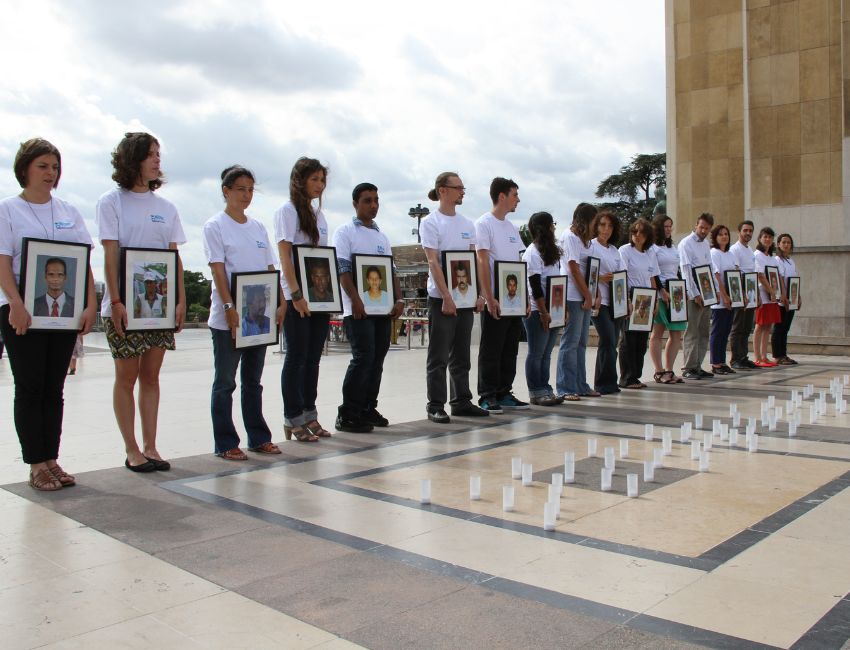
Twenty years ago, Action Against Hunger suffered one of the worst attacks on aid workers ever committed. 17 members of staff were brutally executed in our office in Muttur, Sri Lanka.
And to this day, we are still seeking justice.
Across conflicts, 90% of victims of attacks against humanitarian and UN personnel are national staff. Local colleagues are often the ones directly implementing programmes, and their proximity to the communities we serve can leave them exposed to the greatest risks.
As NGOs, one of our biggest responsibilities is to put all possible safety measures in place for our colleagues and partners, local and international.
But the responsibility cannot rest with humanitarian organisations alone.
The protection of aid workers is ultimately the responsibility of governments and parties in conflict. They must ensure that international humanitarian law is respected.
How international humanitarian law protects aid workers
Conflicts have rules. It’s accountability that’s the problem.
International humanitarian law (IHL) protects humanitarian and health workers carrying out their work. Those in conflict must respect and protect aid workers and facilitate humanitarian efforts. The Geneva Conventions are one of the main frameworks protecting humanitarian workers.
Recent UN Security Council resolutions look to renew commitments to protecting aid workers and humanitarian efforts, highlighting it as part of peace, security and the protection of civilians.
What happens when international humanitarian law is ignored?
States have a responsibility to investigate violations of international humanitarian law and, where appropriate, prosecute those responsible. They can also support international efforts to establish the facts and pursue justice.
But instead, attacks are often condemned and then forgotten.
Disregard for international law is putting humanitarian workers in danger every day. And when attacks – deliberate or not – are not investigated properly, or violations have no consequences, the danger grows even more.
Impunity tells perpetrators that there may be little cost to attacking humanitarian personnel. And when one attack goes unanswered, the risks can multiply for people working on the ground.
Accountability is not separate from protection. It’s part of protection.
How attacks on aid workers affect wider humanitarian efforts
Protecting humanitarian workers is more than just keeping them safe. It must start with those in conflict working with the international community to prevent attacks, threats, detention, and any form of harm against humanitarian personnel.
It also means protecting humanitarian space.
Humanitarian organisations need safe and sustained access to communities affected by conflict. But when aid workers are attacked, organisations may have no choice but to suspend operations or withdraw personnel.
The consequences do not stop with the people who are killed or injured. When humanitarian workers cannot safely reach people in need, civilians lose access to food, healthcare, shelter and other life-saving aid.
There should be diplomatic negotiations that enable humanitarian operations to continue, and ensure that humanitarian workers can carry out their work safely and independently.
An attack on an aid worker can therefore become an attack on the humanitarian operation itself – and ultimately on the people that operation exists to support.
What can be done to protect humanitarian workers
Condemnation is not enough.
Action Against Hunger continues to call for the protection of humanitarian workers and for meaningful accountability when they are attacked.
Governments must use their influence to prevent attacks, demand independent investigations, support accountability, and ensure that perpetrators face consequences when violations occur.
How can the UK Government help?
The UK Government has committed to protecting humanitarian workers and upholding international humanitarian law.
Just last year, the UK Government drafted, promoted and signed the Declaration for the Protection of Humanitarian Personnel, which has now been signed by 119 States. It represents an important expression of international consensus that the protection of humanitarian personnel must be addressed with the utmost urgency.
Now, the UK must turn that commitment into action.
It should use its diplomatic influence and its role on the UN Security Council to push for independent investigations into attacks against humanitarian workers, strengthen international efforts to uphold IHL, protect humanitarian space, and hold perpetrators to account for their choices and actions.
Because when humanitarian workers are attacked, it is an attack on humanity – and on those trying to bring assistance to people in critical and vulnerable situations.
Protecting aid workers is not impossible. Danger, or even death, is not an inevitable consequence of the job.
The danger faced by aid workers is shaped by choices: choices about how hostilities are conducted, whether international law is respected, and how the international community responds when those rules are broken.
The only possible path forward is to demand compliance, pursue accountability, and have the political will to make both a reality.