
Action Against Hunger’s abandoned office in Muttur, Sri Lanka, is an eerily cheerful small building immersed in greenery, painted in blue and white stripes.
This is where, 20 years ago, Action Against Hunger was carrying out humanitarian work to support local communities during a civil war, in the aftermath of the tsunami.
This is where, 20 years ago to this day, 17 young aid workers were lined up, told to kneel on the ground, and shot at close range.
Why was Action Against Hunger in Muttur, Sri Lanka?
In the early 2000s, Sri Lanka faced multiple crises. Communities were still recovering from the devastating 2004 tsunami.
At the same time, the ongoing civil war between the LTTE (Liberation Tigers of Tamil Eelam) and government forces had sparked intense fighting. Thousands of civilians were forced to flee and the north-east of the country, including Muttur, was heavily militarised.
The office in Muttur served as the gateway to the southern part of Trincomalee base, one of our main bases in this area, only reachable by boat.
The teams spent the working week in Muttur, leading the delivery of water, sanitation and hygiene programmes (WASH) and food security – life-saving support for the local communities already caught up in the conflict.
What happened?
On 1 August 2006, the Liberation Tigers of Tamil Eelam (LTTE) took control of the town of Muttur. Subsequent bombing from the Sri Lankan authorities led to thousands of civilians fleeing, but our colleagues remained trapped inside Action Against Hunger’s offices.
After several failed evacuation attempts, our office was clearly marked with Action Against Hunger flags – humanitarian workers are protected under International Humanitarian Law, and our colleagues were assured that all parties to the conflict were aware of this.
On 4 August, the government army announced that they had taken back control of Muttur. That morning, our office fell silent, and all contact with our colleagues was lost.
It was only on 6 August that Action Against Hunger’s staff was allowed to enter the compound. That’s when they discovered 15 bodies lying face down in the courtyard, and two more who had attempted to flee. They were all wearing Action Against Hunger T-shirts.
“They believed their Action Against Hunger t-shirts would save them.”
Following the autopsies, further horrors were uncovered. The bullet trajectories clearly showed that people were made to kneel, and shot from behind.
16 of the victims were of Tamil ethnicity.
Uncovering the truth
This assassination was one of the most shocking, egregious crimes ever committed against humanitarian workers.
Political interference in the investigation was blatant from the very beginning.
Initially, the Sri Lankan authorities blamed the LTTE for the massacre. However, inconsistencies in the military’s accounts sparked further investigations, that continued for more than a decade.
Action Against Hunger itself has continued to investigate, and in 2013 published a damning report identifying the security forces as the responsible party.
In 2015 that an investigative mechanism opened by the UN Human Rights Council confirmed that members of the Sri Lankan security forces were responsible for the Muttur massacre.
The quest for justice
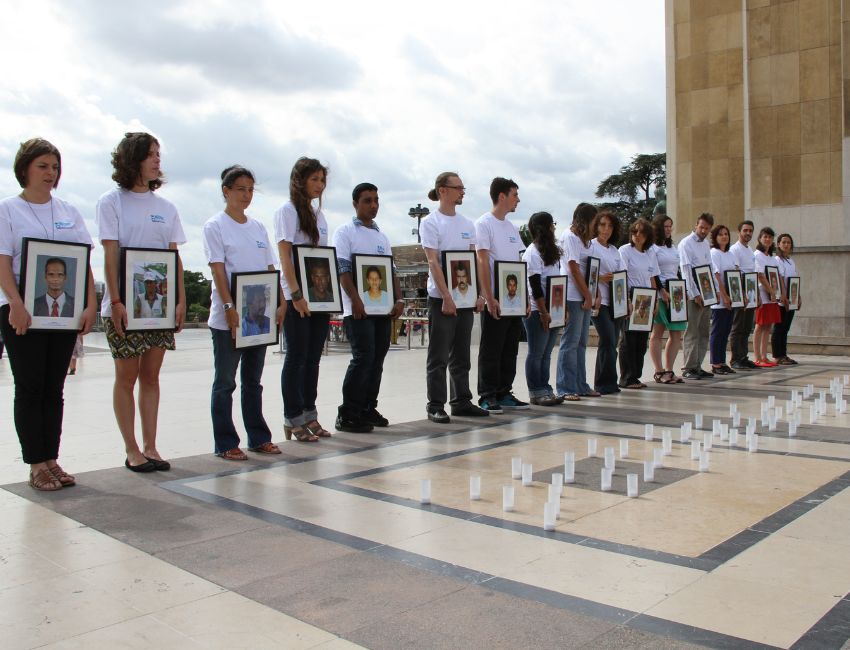
To this day, we are still fighting for justice and for those responsible to be held accountable. For 20 years, Sri Lanka has failed to deliver justice for the victims and their families.
“I am waiting for the day that there is justice. That is when I will truly commemorate my sister, that is the day I will truly light a candle for her,” says another brother of one of the victims.
What happened in Muttur 20 years ago was not just a cold-blood assassination: it was a war crime, a violation of International Humanitarian Law, which protects aid workers in conflict, and of several UN Resolutions.
This is why we’re calling for a new investigation to open now, to put an end to 20 years of impunity, and finally bring some measure of peace to the victim’s families.
Only last month the UK’s Foreign Secretary committed to personally investigate the matter, and we will keep pressing the new government to uphold this promise.
And only a few months ago the UK co-authored and signed a Declaration to Protect Humanitarian Personnel, also committing to seek justice. 118 states have signed it already, including Sri Lanka, and are all bound by the same commitment.
Aid workers continue to risk their lives every day. The past few years have been among the deadliest on record for humanitarian workers worldwide. Impunity cannot be allowed to prevail – not then, and not now.
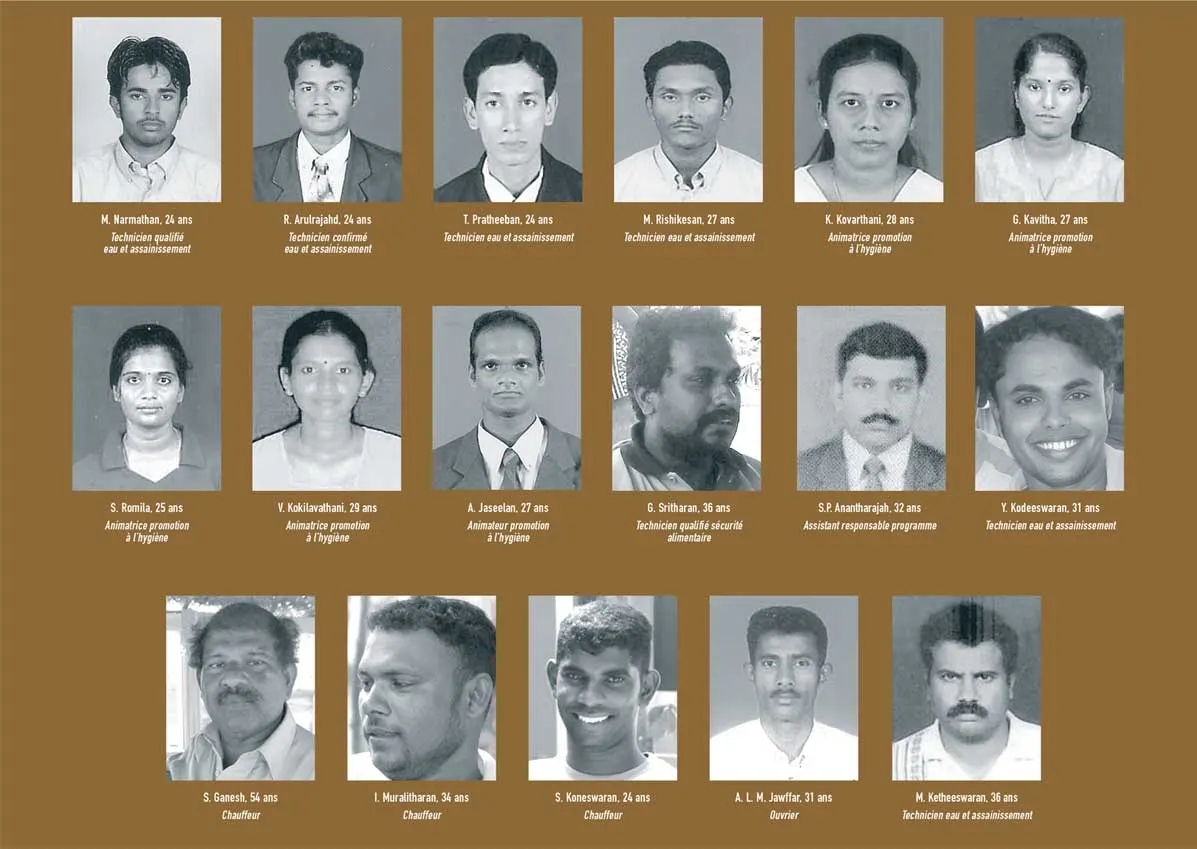
Remembering Action Against Hunger’s staff that lost their lives
Our colleagues’ names were:
- R. Arulrajah, 24 years old
- M. Narmathan, 23 years old
- S. Koneswaran, 24 years old
- T. Pratheeban, 27 years old
- R. Sivapiragasham, 25 years old
- G. Kavitha, 27 years old
- M. Rishikesan, 24 years old
- A. Jaseelan, 27 years old
- K. Kovarthani, 27 years old
- V. Kokilavathani, 29 years old
- A.L.M Jawffar, 31 years old
- Y. Kodeeswaran, 30 years old
- S.P Anantharajah, 32 years old
- I. Muralitharan, 33 years old
- G. Sritharan, 36 years old
- M. Ketheeswaran, 36 years old
- S. Ganesh, 54 years old
Twenty years on, we have not forgotten.
Twenty years on, we continue to seek justice.