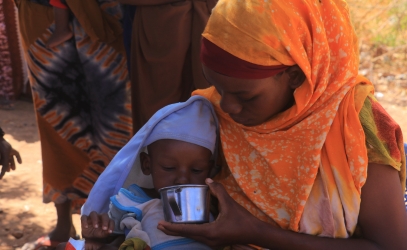

We have been working with Muslim communities since 1980. By making your Zakat donation to Action Against Hunger, you can be sure your payment will help malnourished children and their families in Muslim-majority communities.
Each year, we reach more than 10 million people in over 20 Muslim-majority countries around the world, helping families access food, water and support.
Our Zakat policy has been independently audited by a Zakat specialist and Muslim scholar to ensure we are fully Zakat compliant.
Guidelines and principles for the use of Zakat
Action Against Hunger is committed to collecting and distributing Zakat in accordance with Sharia, and in an honest and ethical manner.
We have a dedicated, interest free bank account for Zakat, where funds are held until being sent to the relevant countries for implementation of Zakat funded projects.
Distribution of Zakat funds
- 100% of all donations will be used solely for Zakat purposes.
- Expenditure will be transparent and Zakat funds will be spent correctly in accordance with the Qur’an, Surah Tawbah, Verse 60 which states that alms are only meant for “the poor, the needy, those who administer them, those whose hearts need winning over, to free slaves and help those in debt, for God’s cause, and for travellers in need”.
- As such, we will only distribute Zakat to beneficiaries (directly or through projects) which are relevant to the categories outlined above.
- Action Against Hunger UK will not allocate funds to each of the categories of Zakat in an equal measure, however, as some categories do not directly apply to its mission.
- We will aim to allocate Zakat funding within one year of receiving it and use it as quickly as possible.
- We will focus its Zakat funding in areas where there is a clear Muslim-majority among the population. However, as a humanitarian organisation, Action Against Hunger UK is bound by the internationally recognised humanitarian principles of impartiality, neutrality, independence and humanity; and will therefore do this in a way that does not discriminate between people on the grounds of race, religion, sect, gender or ability.
- Action Against Hunger UK considers itself to be a legitimate administrator of Zakat: a duty bearer, with a responsibility to respect, protect and fulfil the rights of beneficiaries on whose behalf Zakat funds have been collected.
Giving your Zakat through Action Against Hunger FAQs
What will Zakat donations be spent on?
When you donate Zakat, you’re allowing us to continue our vital, life-saving work,
including:
- Responding to emergencies to save lives in Muslim-majority countries.
- Helping people (including refugees and internally displaced people) in Muslim-majority communities who are facing life-threatening hunger. For example, providing food baskets, hot meals, cooking kits, therapeutic food for a malnourished child or livestock to help feed a family.
Can Gift Aid be claimed on Zakat donations?
Gift Aid can be claimed on Zakat payments. UK taxpayers can claim Gift Aid, which will be reclaimed by Action Against Hunger and treated as a general donation to support our work.
What about Sadaqah?
Sadaqah is an entirely voluntary act of charity and worship, where any amount can be
given at any time of year. Donations can be used for any project or programme to
benefit people. This document covers only the handling of Zakat payments.